Swipe fatigue is the emotional exhaustion and decision-making paralysis that sets in after sustained use of swipe-based dating apps like Tinder, Bumble, and Hinge. It's decision fatigue (the well-documented cognitive phenomenon where repeated choices degrade judgment) applied to dating. If you open the app and close it within seconds, match but never message, or feel worse after using the app than before, you're almost certainly experiencing it.
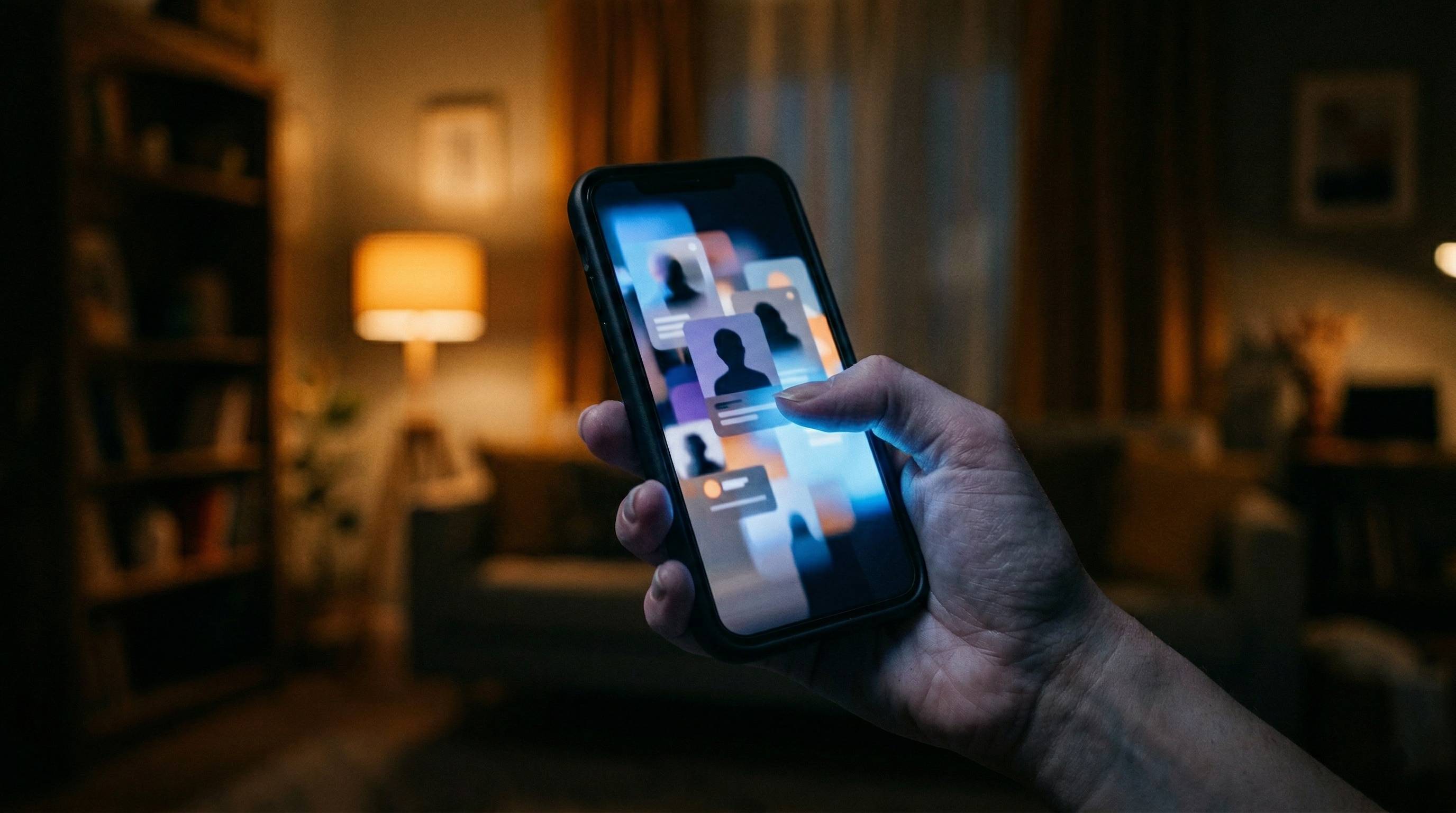
What Is Swipe Fatigue and Why Does It Happen?
Swipe fatigue is a direct consequence of what psychologists call decision fatigue. The brain can make a limited number of high-quality decisions before it starts defaulting to impulse or inaction. Dating apps present you with hundreds of profiles in a single session. Each swipe is a micro-decision, and past a threshold, your brain automates all of them.
The result: you stop reading profiles. You react to photos on instinct. Matches pile up in your inbox but writing "hey" feels like effort. You close the app and repeat the cycle next time.
How Dating Apps Cause Burnout: The Evidence
This isn't anecdotal. Hinge's 2025 D.A.T.E. study, conducted with approximately 30,000 users, found that the majority of users reported negative rather than positive emotions while using dating apps. A 2026 study by Wheatley and the Institute for Family Studies, with a sample of 5,275 individuals, found a similar pattern: heavy app usage correlates negatively with date quality, not positively.
The data points to a structural issue. The problem isn't your approach to dating. It's a system designed to maximize your time on-screen, not the quality of your connections.
Symptoms: How to Know If You Have Swipe Fatigue
If several of these patterns feel familiar, you're likely dealing with the dating version of decision fatigue:
- The open-close loop. You launch the app, look for 10–15 seconds, and leave without doing anything.
- The match-silence pattern. Matches arrive but initiating conversation feels disproportionately effortful. Your inbox grows untouched.
- Post-session dip. You feel lower energy or mood after using the app than before you opened it.
- Mechanical swiping. You've stopped reading bios entirely; your thumb moves on autopilot based on photos alone.
- Everybody looks the same. After hundreds of profiles, individuals become interchangeable.
The Choice Paradox: Why Infinite Options Paralyze You
Psychologist Barry Schwartz's Paradox of Choice framework explains this well: beyond a certain threshold, more options decrease satisfaction and degrade decision quality. Sheena Iyengar and Mark Lepper's famous 2000 jam experiment demonstrated this concretely: shoppers offered 24 jam varieties were far less likely to purchase than those offered 6.
In dating apps, this effect is amplified because the stakes feel higher than jam. Every "wrong" swipe registers as a potentially missed connection, which drives either obsessive scrutiny or total disengagement. Neither leads anywhere good.
Variable-Ratio Reinforcement: The Slot Machine Effect
Most swipe-based apps use what behavioral science calls a variable-ratio reinforcement schedule, the same mechanism that makes slot machines addictive. The reward (a match) arrives at unpredictable intervals, which creates a persistent urge to keep pulling the lever, to keep swiping. Even when matches don't come, the feeling of "maybe the next one" keeps you in the app.
This design doesn't optimize for your experience. It optimizes for screen time.
How to Deal with Dating App Burnout
Knowing the problem is structural means the solution needs to be structural too. Individual strategies like "only use it 15 minutes a day" or "take a week off" manage symptoms but don't change the underlying design. The real question is: What happens when a system replaces infinite choice with limited, intentional selection?
Research is consistent: when people are given fewer but higher-quality options, they're more satisfied with their choice, invest more in it, and experience less regret. Applied to dating, this means redirecting the energy spent swiping toward genuinely getting to know a small number of people.
What If There Were No Swipe at All?
Valeur is a dating app that answers this question at the infrastructure level. There's no infinite profile feed. Instead, every day at 5:00 PM, you receive 1 to 9 matches selected through PRISMA, a psychology-inspired personality system that maps internal motivations, conflict styles, and emotional patterns.
This isn't a feature. It's the structural elimination of decision fatigue. When options are limited, you actually read profiles. You approach matches with intention. In conversation, you're the focus, not one of 47 open threads.
Swipe fatigue isn't a willpower failure. It's a design flaw. Valeur is a system built without that flaw.
Frequently Asked Questions
What is swipe fatigue?
Swipe fatigue is the emotional exhaustion and decision-making paralysis caused by evaluating too many profiles on dating apps. It's decision fatigue applied to dating: after too many micro-decisions, your brain either acts on impulse or shuts down entirely.
Why do dating apps make you feel bad?
Most apps use variable-ratio reinforcement (the same psychological mechanism behind slot machines) to keep you swiping. This design optimizes for screen time, not meaningful connection. Hinge's 2025 D.A.T.E. study of approximately 30,000 users found that most users experience negative emotions while using dating apps.
How do I get over dating app fatigue?
Individual tactics (time limits, app detox) can manage symptoms, but lasting change requires a structural shift: moving to a system that offers fewer, carefully selected matches. Research consistently shows that fewer options lead to higher decision quality and greater satisfaction.